Hemophilia Treatment Cost In India
Unlock Exclusive Discount : Your Gateway to Premium Healthcare with Medsurge India Health Value Card.

Unlock Exclusive Discount : Your Gateway to Premium Healthcare with Medsurge India Health Value Card.
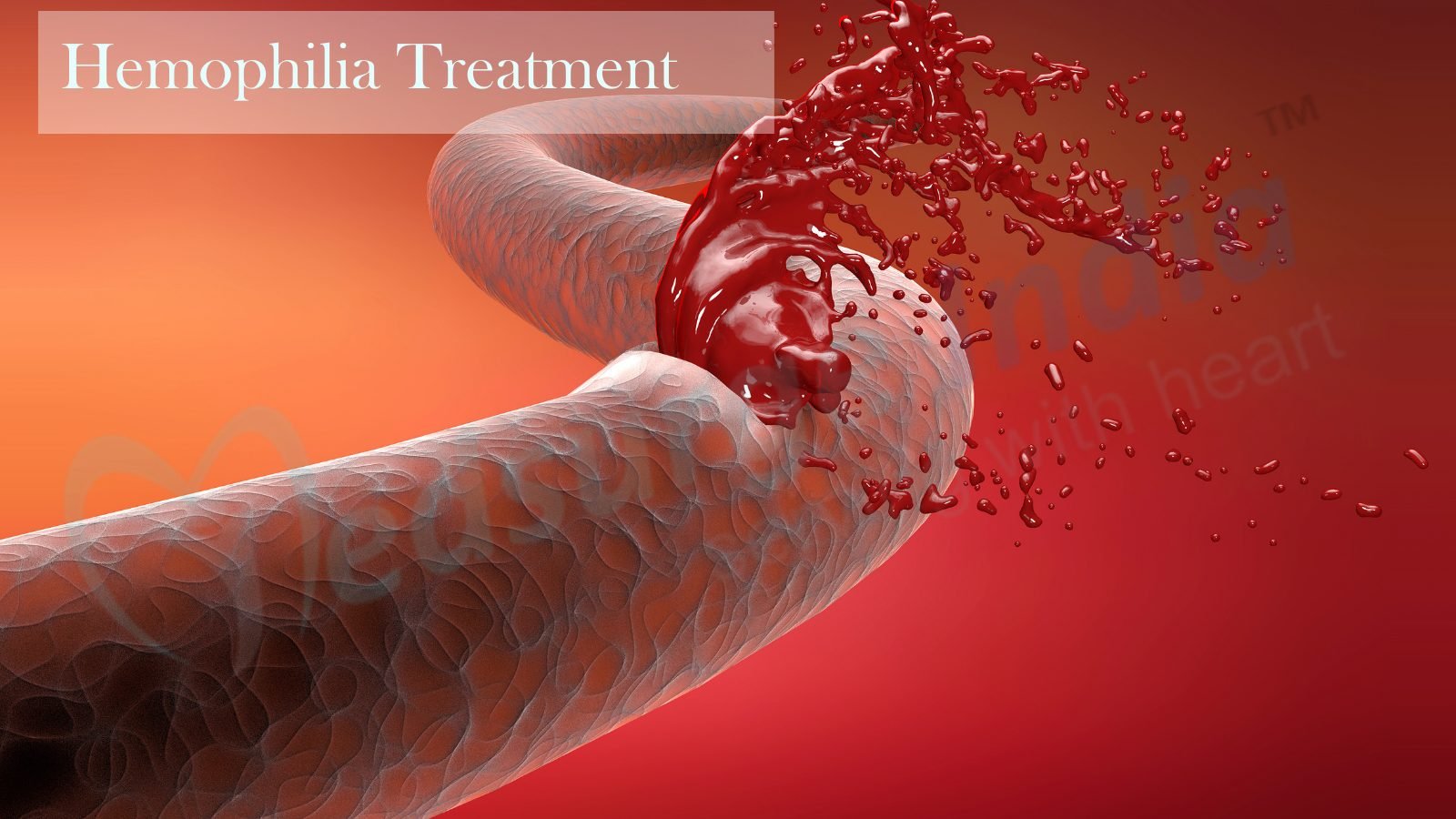
Hemophilia is a clotting condition that causes the blood to clot slowly. Following an injury, surgery, or having a tooth extracted, people with this syndrome experience persistent bleeding or dribbling. Continuous bleeding occurs in severe cases of hemophilia after minimal trauma or even in the absence of injury (spontaneous bleeding). Bleeding into the joints, muscles, brain, or other internal organs can have serious consequences. Milder varieties of hemophilia do not always cause spontaneous bleeding, and symptoms may not appear until abnormal bleeding occurs after surgery or a catastrophic accident.
It is natural for humans to get sick or injured over the course of their lives. When we are harmed, our body’s clotting mechanism fights to stop the bleeding. However, in certain cases, blood does not clot and bleeding cannot be regulated by the body naturally due to a gene malfunction. Hemophilia is a bleeding disorder that is extremely rare. This gene is then handed down through the generations and reason to that Hemophilia is considered as an inherited condition.
Hemophiliacs, or people who have hemophilia, are born without the clotting factor, which is handed down in families. This clotting factor is a protein found in the blood that helps to keep bleeding under control. Both males and females are affected by hemophilia. Hemophiliac men pass the mutated gene to their daughters but not to their sons. Sons with the gene, on the other hand, will be born with hemophilia. Some women who carry the gene can have significant bleeding difficulties and pass the mutation on to their sons and daughters.
While hemophilia is more commonly found in families with a history of the disorder, it has also been reported in families without a history of the blood disorder. This unusual kind of hemophilia is known as acquired hemophilia, and it occurs when the body’s immune system targets clotting components within the body. Treatment for Haemophilia will be different for acquired kind.
Hemophilia generally always affects men, although in rare cases, a female can be affected as well.
Inherited hemophilia is divided into two types:
Type A: It is the most frequent variety and is caused by a lack of factor VIII, a protein that aids in the formation of clots in the blood. Classic hemophilia is the name given to this kind.
Type B: A lack of factor IX causes type B hemophilia. Christmas sickness is another name for this variety.
Hemophilia is most commonly diagnosed at birth, although it can also be acquired later in life if the body produces antibodies that attack and destroy clotting components. This kind of hemophilia is, however, extremely uncommon. Acquired hemophilia, commonly known as autoimmune hemophilia or acquired hemophilia A, is a type of acquired hemophilia (AHA).
Treatment for Hemophilia is determined by the type of Haemophilia individual consisting.
Bleeding, either persistent external bleeding or bruising after little trauma or for no apparent reason is the most common symptom. The severity of the symptoms varies depending on whether the patient has a mild, moderate, or severe case of the disorder.
Hemophilia signs and symptoms differ based on the number of clotting factors. You may only bleed after surgery or trauma if your clotting factor level is mildly lowered. If you have a significant deficiency, you can bleed easily and for no apparent cause.
The following are signs and symptoms of spontaneous bleeding:
Excessive bleeding from cuts or wounds, especially after surgery or dental work, for no apparent reason
For people with severe hemophilia, brain bleeding is a serious condition. It is possible that it will put your life in danger. If you see any of the following indicators of bleeding, seek medical attention right away:
When a person bleeds, the body usually aggregates blood cells into a clot to stop the bleeding. Clotting factors are proteins in the blood that help platelets form clots by interacting with them. When a clotting factor is lacking or the levels of the clotting factor are low, hemophilia development takes place.
Only the X chromosome contains the genes that control the synthesis of factors 8 and 9. Mutations in the factor VIII or factor 9 genes on the X chromosome causes hemophilia.
Hemophilia is frequently inherited, which means that a person is born with it (congenital). Low clotting factor type is used to classify congenital hemophilia and that is a major cause of hemophilia.
Hemophilia A is the most frequent kind, which is linked to a low level of factor 8. Hemophilia B, which is associated with a low level of factor 9, is the next most frequent form.
Hemophilia can develop in people who have no family history of the disease. Acquired hemophilia is the medical term for this condition.
Acquired hemophilia is a type of hemophilia that occurs when the immune system targets the blood’s clotting factor 8 or 9. It has a connection to:
The presence of hemophilia in one’s family is the most significant risk factor. Hemophilia is far more common in men than it is in women.
Hemophilia Treatment Cost in India starts from USD 2,300. The hemophilia treatment can vary depending on various factors such as the place and location you choose for your treatment.
| Cities | Starting Price |
| Delhi | USD 2,300 |
| Gurgaon | USD 2,300 |
| Noida | USD 2,200 |
| Mumbai | USD 2,400 |
| Hyderabad | USD 2,300 |
| Chennai | USD 2,300 |
| Kolkata | USD 2,200 |
| Bangalore | USD 2,500 |
Please keep in mind that prices of Hemophilia Treatment Cost in India will vary depending on the various factors.
The following here are some variables that can affect Hemophilia Treatment Cost in India:
The standard and excellence of medical treatment and amenities are comparable to those of the most prominent healthcare facilities in the world, even after deducting the cost of lodging, meals, and transportation. Under the direction of the most skilled physicians, Medsurge India provides the lowest Hemophilia Treatment Cost in India for patients.
A blood test is used to diagnose hemophilia. A little sample of blood will be taken from your vein and the level of clotting factor present will be measured by your doctor.
After that, the sample is assessed to determine the degree of the factor deficiency and the condition.
The following are the several levels of Hemophilia A severity:
Mild: occurs when the level of a component is between 6% and 30%. (about 25 percent of all cases)
Moderate: When factor levels are between 1% and 5% (about 15 percent of all cases)
Severe: When factor levels are fewer than 1%, it is considered severe (about 60 percent of all cases)
The following are the several levels of Hemophilia B severity:
Mild: occurs when the level of a factor is between 6% and 49%.
Moderate: When factor levels are between 1% and 5%, it is considered moderate.
Severe: When factor levels are fewer than 1%, it is considered severe.
For Hemophilia treatment in India, doctors will first determine the type as Hemophilia Treatment varies depending on the type of hemophilia you have. Treatment’s major goal is to replenish clotting factors so that a person can form clots and stop bleeding.
A lack of clotting Factor 8 in the blood causes this bleeding condition. Hematology doctors will inject a medicine called desmopressin, which is a clotting Factor 8 that can temporarily raise the concentration of Factor 8 in your blood.
This form of the bleeding problem is caused by the lack or malfunction of clotting Factor 9. Replacement therapy, which helps boost the level of Factor 9 in the blood, is the most effective treatment. Infusing clotting agents, on the other hand, helps protect blood clots and keeps them in place to stop bleeding. Depending on the degree of the bleeding, both may be used concurrently.
Depending on the type of hemophilia you have, your doctor may prescribe the further following treatment:
It's important to remember that patients with hemophilia should avoid aspirin and ibuprofen. Blood clotting may be hampered by certain medications.
To ensure that clotting factors created from donated blood are even safer, receive hepatitis A and B immunizing vaccinations.
Finally, to preserve excellent health, follow the advice given to persons who do not have hemophilia:
A: In persons with hemophilia, doctors frequently prescribe acetaminophen, such as Tylenol, for pain treatment. Take no aspirin, ibuprofen (Advil or Motrin), Aleve, or other nonsteroidal anti-inflammatory drugs (NSAIDs), or medicines containing salicylate. These medications have the potential to induce bleeding.
A: The use of paracetamol with trimeperidine in hemophiliac patients (even if they have hepatitis C) within the first 24 hours following high-trauma procedures is both effective and safe. Hemophiliac sufferers' pain is a serious issue.
A: The use of paracetamol with trimeperidine in hemophiliac patients (even if they have hepatitis C) within the first 24 hours following high-trauma procedures is both effective and safe. Hemophiliac sufferers' pain is a serious issue.
A: While hemophiliacs' thrombin generation is substantially compromised, primary hemostasis, or platelet function, has long been assumed to be normal. However, several investigations have found that hemophilia patients had longer bleeding periods, implying that primary hemostasis is also impacted.
A: The bleeding time test is used to determine how well blood clots in a person's body. The time it takes for the arteries to contract and platelets in the blood to seal the hole is measured in this test.

Hematologist
Consultant
12+ Years
Care Hospital, Banjara Hills, Hyderabad
View Doctor
Hematologist
Associate Director
11+ Years of Experience
Max Super Speciality Hospital, Patparganj, New Delhi
View Doctor
Hematologist
Senior Consultant
15+ years of experience
Manipal Hospital, Panaji, North Goa
View Doctor
Hematologist
Senior Consultant
12+ years of experience
Manipal Hospital, Panaji, North Goa
View Doctor
Hematologist
Senior Consultant
20+ years of experience
KMC Hospital, Hampankatta, Mangaluru
View Doctor
Hematologist
Senior Consultant
42+ years of experience
NH Rabindranath Tagore International Institute of Cardiac Sciences, Kolkata
View Doctor
Hematologist
Senior Consultant
25+ years of experience
NH Rabindranath Tagore International Institute of Cardiac Sciences, Kolkata
View Doctor
Hematologist
Senior Consultant
14+ years of experience
NH Rabindranath Tagore International Institute of Cardiac Sciences, Kolkata
View Doctor
Hematologist
23+ years of experience
Narayana Superspeciality Hospital, Shibpur, Howrah
View Doctor
Hematologist
Senior Consultant
18+ years of experience
Narayana Multispeciality Hospital, Andul Road, Howrah
View Doctor








By using our site, you agree to our Terms and Conditions, Privacy Policy and Refund Policy. Medsurge India provides reliable healthcare information and treatment options to support informed decision-making. Our content is designed to support and complement the guidance of your treating doctor, helping you feel informed and confident throughout your healthcare journey. We also Accept International Payments.

Copyright © 2025 NSM ONLINE SOLUTIONS PRIVATE LIMITED. All rights reserved.

 (1).png)