Targeted Alpha-PRRT Therapy
Unlock Exclusive Discount : Your Gateway to Premium Healthcare with Medsurge India Health Value Card.

Unlock Exclusive Discount : Your Gateway to Premium Healthcare with Medsurge India Health Value Card.
Targeted Alpha Peptide-receptor-radioligand-therapy (PRRT) is a kind of molecular therapy (also known as radioisotope therapy) that is used to treat neuroendocrine tumors (NETs).
Alpha PRRT uses alpha-emitting radionuclides such as actinium (Ac225), bismuth (Bi213), or lead (Pb212) to mark particular peptides and monoclonal antibodies.
The conjugated compounds selectively connect to certain receptors on the surface of cancer cells, allowing them to target cancer cells.
In PRRT, a cell-targeting protein (or peptide), identical to the natural circulating hormone somatostatin, is mixed with a small amount of radioactive material, or radionuclide, to create a radiopeptide, a unique sort of radiopharmaceutical.
This radiopeptide travels and binds to neuroendocrine tumor cells after being injected into the patient’s bloodstream, giving a concentrated high dosage of radiation precisely to the cancer cells.
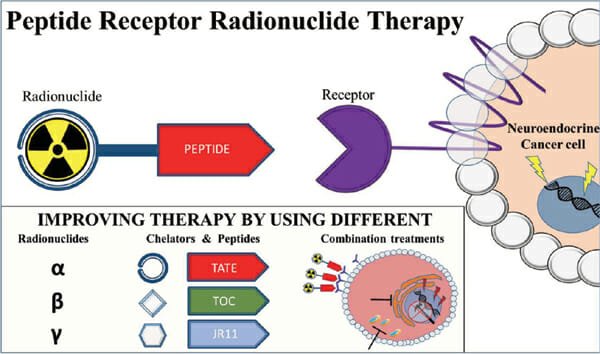
The mechanism by which this radiopeptide can target the tumor cell is the abundance (called an overexpression) of a specific type of surface receptor—a protein that extends from the cell’s surface—that binds to somatostatin
What Conditions Are Treated with PRRT?
PRRT is used to treat neuroendocrine tumors, such as gastro-entero-pancreatic NETs, which are specific tumors that originate from the stomach, intestine, or pancreas, and are also known as carcinoids and islet cell carcinomas of the pancreas, and are the current USFDA (United States Federal Drug Association)-approved indication.
Many of the constraints of conventional Lutetium (Lu177) PRRT that might be alleviated with targeted alpha PRRT are mentioned below:
Who are the Targeted Patients?
Peptide-receptor-radioligand-therapy (PRRT) is a good option of treatment for patients like:
The most common protocol referred to performing the Alpha Targeting PRRT therapy includes the following steps:
This special type of nuclear medicine therapy is performed as a full-day outpatient procedure but, in rare circumstances, a patient may be required to stay overnight as a precaution.
Molecular imaging scans (e.g. post-treatment Lu-177 scans) are being used to see where the injected radiopeptide has progressed in the body during and after therapy.
PRRT and other molecular therapies provide more individually focused cancer treatment because radiopeptides can be adjusted to the patient’s specific biologic traits as well as the tumor’s molecular properties.
The therapy is well-considered because radiopeptides are very selective in their capacity to precisely reach and target neuroendocrine tumor cells while limiting radiation exposure to healthy tissues.
PRRT is a highly effective therapy option for advanced, metastatic, or incurable progressive neuroendocrine tumors. Although PRRT is rarely curative, it has been demonstrated to alleviate symptoms, decrease tumor lesions, and halt disease progression.
Adverse Effects of therapy?
Alpha PRRT with a specific target is well tolerated. During the infusion and for a few days afterward, some patients suffer nausea. The nausea is usually minor and can be treated with over-the-counter anti-nausea medication.
There have been rare cases of delayed minor renal function derangement, but no patients have gone into irreversible renal failure. There is also no evidence of hematological harm.
A lowering of blood cell counts, which is mild to moderate in the majority of instances, is one of the long-term side effects.
There are very few long-term side effects, such as irreversible kidney damage or the emergence of secondary hematologic neoplasms (a condition known as a myelodysplastic syndrome). The majority of patients tolerate the treatment well.
Is PRRT a Chemotherapy?
As a result, as compared to chemotherapy, PRRT often has less adverse effects. PRRT is a highly successful therapy option for managing advanced, progressing neuroendocrine tumors.
PRRT is not a cure, but it has been demonstrated to help reduce symptoms and halt the disease’s course.
Is Targeted Therapy Better than Chemotherapy?
Chemotherapy and targeted therapy are two cancer-fighting medicines. Chemotherapy is more damaging to healthy cells than targeted therapy.
Both of these techniques are frequently used in conjunction with other therapies like radiation.
Although targeted therapy is technically a form of chemotherapy but it does not work in the same way. The following are some of the distinctions between chemotherapy and targeted therapy:
Conclusion
The therapy’s goal is to stabilize the disease while attempting to increase progression-free survival. Over the last two years, nuclear oncologists have seen about 75–80% of patients on alpha PRRT acquire medical stabilization, with the majority reporting a significant improvement in their quality of life. Most patients report relief from discomfort and diarrhea, as well as an improvement in their overall health.
By using our site, you agree to our Terms and Conditions, Privacy Policy and Refund Policy. Medsurge India provides reliable healthcare information and treatment options to support informed decision-making. Our content is designed to support and complement the guidance of your treating doctor, helping you feel informed and confident throughout your healthcare journey. We also Accept International Payments.

Copyright © 2025 NSM ONLINE SOLUTIONS PRIVATE LIMITED. All rights reserved.

 (1).png)