Enlarged Prostate Surgery Cost In India
Unlock Exclusive Discount : Your Gateway to Premium Healthcare with Medsurge India Health Value Card.

Unlock Exclusive Discount : Your Gateway to Premium Healthcare with Medsurge India Health Value Card.
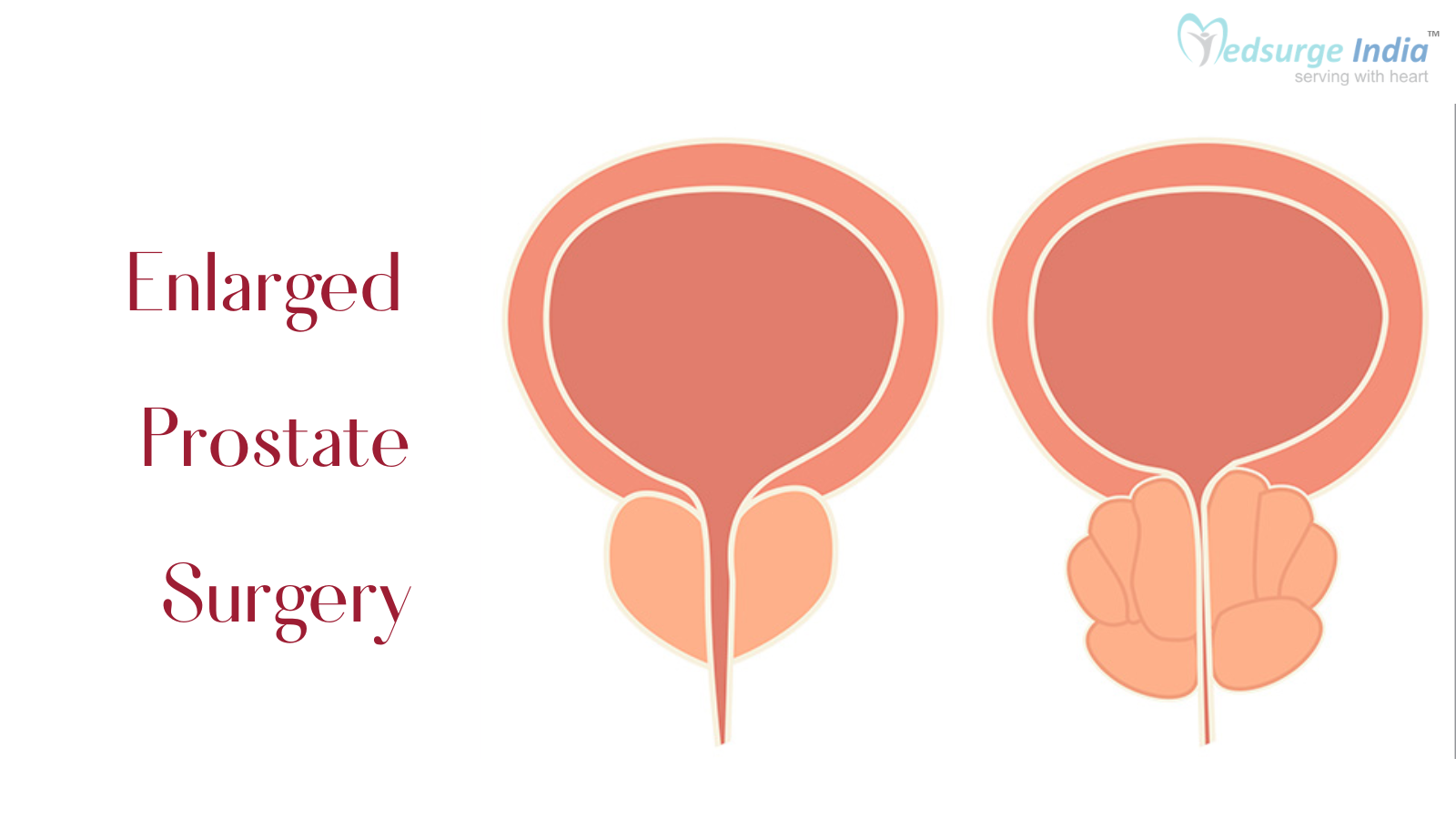
An enlarged prostate, also known as Benign Prostatic Hyperplasia (BPH), is a condition in which the body’s hormone balance changes with age, causing the prostate gland to grow. An enlarged prostate gland can cause uncomfortable urinary symptoms such as urine blockage. It can also cause problems with the bladder, urinary tract, or kidneys. Enlarged Prostate Surgery in India is available at any major multi-specialty or urology hospital. Many patients from all over the world travel thousands of miles to India for prostate enlargement treatment. This is primarily due to the low cost of medical treatment and the availability of high-quality care. Furthermore, there is virtually no waiting time for patients who travel from other countries to India.
The Cost of Enlarged Prostate Surgery in India is significantly lower than in any other country around the world. This is despite the fact that the best hospitals in India for enlarged prostate treatment use cutting-edge technology and diagnostic and imaging methods to assist surgeons in performing treatment effectively and efficiently.
Benign prostatic hyperplasia (BPH) is a non-cancerous enlargement of the prostate gland in men. Benign prostatic hyperplasia is also known as benign prostatic hypertrophy or benign prostatic obstruction.
As a man ages, his prostate goes through two major growth periods. The first is when the prostate doubles in size during puberty. The second stage of development begins around the age of 25 and lasts for the rest of a man’s life. The second growth phase is frequently associated with benign prostatic hyperplasia.
As the prostate grows in size, it presses against and pinches the urethra. The bladder’s wall thickens. The bladder may eventually weaken and lose its ability to completely empty, leaving some urine in the bladder. Many of the problems associated with benign prostatic hyperplasia are caused by urethral narrowing and urinary retention (the inability to completely empty the bladder).
This is a non-cancerous enlargement of the prostate gland. Enlarged prostate is a common condition that is found in men as they age. This is not a cancerous disease as compared to prostate cancer but it does affect how you urinate or pee.
Two types of prostate enlargement are known and said to differ in the way it grows:
The average Enlarged Prostate Surgery Cost In India start from $3,800 (INR 3.16 Lakh), when compared to other countries, India has relatively low treatment costs. The standard of medical care and services is also comparable to that of the world’s best hospitals even after travel, accommodation, and food.
Factors That Can Affect Enlarged Prostate Surgery Cost In India
Below are some symptoms of an enlarged prostate include:
As prostate gland is related to the urinary system. Here are some of the possibilities that can relate to urinary symptoms:
The cause of enlarged prostate or benign prostatic hyperplasia is unknown; however, it primarily affects older men. Men who had their testicles removed before puberty do not develop benign prostatic hyperplasia. As a result, some researchers believe that aging and testicular factors may contribute to benign prostatic hyperplasia.
Men produce testosterone, a male hormone, and trace amounts of estrogen, a female hormone, throughout their lives. The amount of active testosterone in men’s blood decreases as they age, leaving a higher proportion of estrogen. According to scientific evidence, benign prostatic hyperplasia occurs because a higher proportion of estrogen in the prostate increases the activity of substances that promote prostate cell growth.
Another theory revolves around dihydrotestosterone (DHT), a male hormone involved in prostate development and growth. According to some studies, even when blood testosterone levels fall, older men continue to produce and accumulate high levels of DHT in the prostate. This DHT buildup may encourage prostate cells to proliferate further. Men who do not produce DHT do not develop benign prostatic hyperplasia, according to researchers.
Certain tests can be performed to determine whether or not your prostate has enlarged. Whereas some tests will be performed by general practitioners (GPs), others will be performed by a doctor who specializes in urinary problems, such as a urologist.
Early detection is critical because if left untreated, it can lead to a urinary tract infection. A test can differ from person to person, but the following are some of the most common tests performed to diagnose enlarged prostate:
Surgery for EP in India may be required depending on the severity of your symptoms. We will learn more about the various types of surgery used to treat BPH or an enlarged prostate in this section. When the growth has reached the urethra, surgery is performed. The following are the surgical procedures used to treat enlarged prostate in India:
Prostate laser surgery or holmium laser enucleation of the prostate (HoLEP): A laser is used to destroy the cells surrounding the prostate gland and then seal the blood vessels in this minimally invasive procedure. Depending on the size of the gland, this procedure can take a long time. This procedure includes:
Surgeries are performed under spinal or general anesthesia. EP surgery recovery time can range from a few weeks to several months. You are also be treated by the best surgeons and urologist in India who has a deep knowledge of the disease and will give you proper advice regarding EP.
Apparently, in some cases, the entire cost of EP surgery in India can vary depending on a number of criteria, such as:
Surgery for EP is common and generally safe. However, there are risks associated with surgery, such as those associated with anesthesia. Urine-related risks can occur following procedures:
Other risks include:
Alpha-blockers like Alfuzosin (Uroxatral), Prazosin (Minipress), and Tamsulosin (Flomax) are used to relax muscles in your bladder and prostate. And 5-Alpha reductase Inhibitors like Finasteride (Propecia, Proscar) and Dutasteride (Avodart) are used to stop your body from creating hormones that make your prostate larger.
As stated above, this enlarged prostate can be caused by age and can be treated with various procedures or surgeries. If left untreated, the symptoms of this disease can cause difficulties in your daily life and at work. If you or someone you know is experiencing any of the above symptoms, see a doctor or get a health check-up so that EP can be avoided sooner.
For men with mild or troubling symptoms, a healthcare provider may recommend lifestyle changes. Changes in lifestyle can include:
Best Hospitals for Enlarged Prostate Surgery in India
1. Apollo Hospitals, Greams Road, Chennai
2. Fortis Hospital - Gurgaon
3. Max Hospital - Delhi
4. Wockhardt Hospitals - Mumbai
5. Artemis Hospital - Gurgaon
6. Indraprastha Apollo Hospital - New Delhi
Best Doctors for Enlarged Prostate Surgery in India
1. Dr. Mohan Keshavamurthy
2. Dr. Avanish Arora
3. Dr. Rajesh Ahlawat
4. Dr. Anant Kumar
5. Dr. Vineet Malhotra
Medsurge India is a prestigious support system for patients looking for doctors, hospitals, and specialized treatments. We'll find the most suitable medical options for you. Regarding your medical issues, our team will give you a list of certified, reputable, and trusted doctors and hospitals. Additionally, we offer a treatment strategy that fits your budget. Apart, we assist patients with obtaining travel authorizations, medical visas, and a multitude of other things.
A: Although there is no cure for benign prostatic hyperplasia (BPH), also known as an enlarged prostate, there are several effective treatment options. Treatments target prostate growth, which causes BPH symptoms.
A: Surgery can significantly reduce the problems caused by a benign enlarged prostate. It is considered if other treatments are ineffective or if the enlarged prostate continues to cause medical problems such as urinary tract infections.
A: Open prostatectomy, HoLEP, and transurethral prostatectomy are surgical options for men with prostate volumes greater than 80 mL.
A: So, if we remove the prostate, what begins to stop urinary flow? There is no answer! If there is urine in the bladder (which there always is), it will flow right out. Men who do not have a prostate need to find another way to control their urination.
A: The most common treatment for BPH is transurethral resection of the prostate (TURP). Your urologist will insert a rigid instrument called a resectoscope into the urethra during this procedure. This is why it is referred to as transurethral. This method of inserting the scope avoids cutting into the prostate.






By using our site, you agree to our Terms and Conditions, Privacy Policy and Refund Policy. Medsurge India provides reliable healthcare information and treatment options to support informed decision-making. Our content is designed to support and complement the guidance of your treating doctor, helping you feel informed and confident throughout your healthcare journey. We also Accept International Payments.

Copyright © 2025 NSM ONLINE SOLUTIONS PRIVATE LIMITED. All rights reserved.

 (1).png)