Percutaneous Transhepatic Biliary Drainage Treatment Cost in India
Unlock Exclusive Discount : Your Gateway to Premium Healthcare with Medsurge India Health Value Card.

Unlock Exclusive Discount : Your Gateway to Premium Healthcare with Medsurge India Health Value Card.
Know Your Treatment Cost
Fast Response · No Hidden Charges
🔒 Response within 24hr
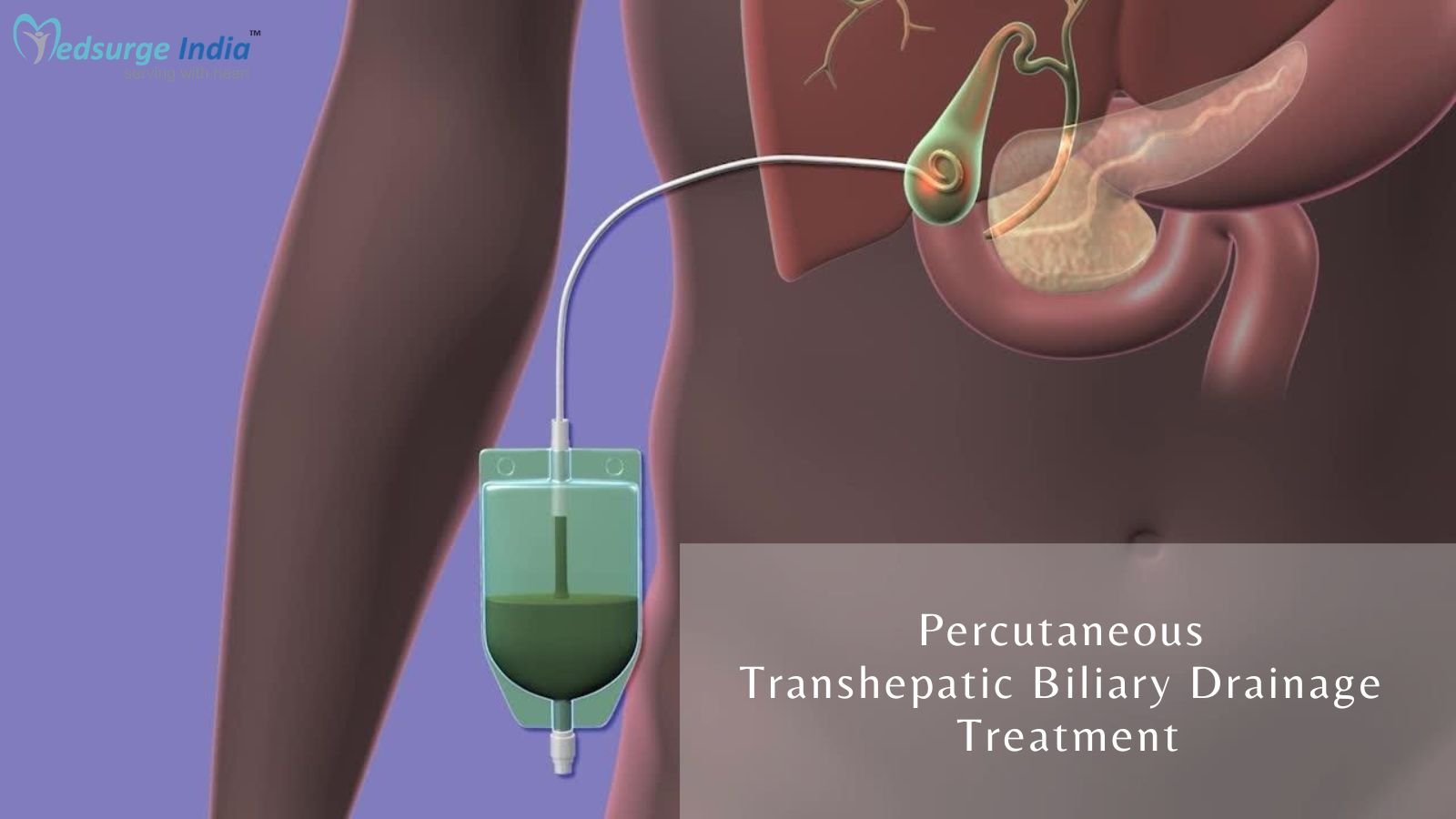
Percutaneous Transhepatic Biliary Drainage (PTBD) in India is a procedure that involves inserting a tiny catheter into the liver via an incision in the abdomen and then threading it through the bile ducts to reach blocked areas. By draining fluid or bile from the liver, medical professionals can relieve pressure and/or enable direct delivery of medicine to the blockage.
When compared to other developed countries, the cost of Percutaneous Transhepatic Biliary Drainage (PTBD) treatment in India is surprisingly low. The interventional radiologist’s expertise and the cutting-edge medical technology used in Indian hospitals may have contributed to the procedure’s success. Aside from these benefits, India’s low costs without lowering clinical standards play an important role in its mainstream appeal.
Bile, which the liver produces, aids in the breakdown of lipids. Bile travels through several small tubes known as ducts, which empty into a larger duct known as the common bile duct. The common bile duct empties into the duodenum, the small intestine’s first segment. The gallbladder also serves as a bile storage space for the liver. Bile cannot properly drain if the bile duct becomes clogged, so it accumulates prior to the obstruction. Clogged bile ducts cause jaundice, dark urine, chalk-colored faeces, itching, nausea, and appetite loss. Because this illness has the potential to be severe, treatment is required.
Percutaneous transhepatic biliary drainage is a treatment where a thin, flexible plastic tube is inserted through the skin into the liver to clear a clogged bile duct system.
PTBD treatment cost in India starts from USD 1500. India has significantly lower healthcare costs than other countries. Furthermore, the quality of the medical services and treatment provided there is on par with that of the best hospitals in the world.
The entire cost of PTBD treatment in India can vary depending on a number of criteria, such as
An obstruction or abnormal bile duct narrowing is the most common cause of percutaneous biliary drainage (PBD) (stricture). Several factors can contribute to this, including:
Bile can leave the liver via a different route with percutaneous biliary drainage. Draining may be necessary to prepare for surgery or other bile duct procedures, such as the removal of a bile duct stone or tumor.
Percutaneous Transhepatic Biliary Drainage (PTBD), however, needs to be avoided when;
Because each patient is unique, it is important to remember that what is good for one patient may not be good for another. As a result, it’s critical to consult with your doctor before deciding on a PTBD procedure.
The impressive growth of Indian medical tourism in recent years demonstrates how far the industry has progressed. Healthcare is one of the industries that has contributed the most revenue and is rapidly expanding. Both public and private organizations contribute to the healthcare sector. In terms of medical tourism, India has an advantage over other countries because of the following:
[related_hospital label=”TOP HOSPITALS” title=”Best Hospitals in India” url=”https://medsurgeindia.com/best-hospitals-in-india/”]
The treatment for obstructed bile ducts is called percutaneous transhepatic biliary drainage (PTBD). Typically, sedation and local anesthesia are used during the surgery. The PTBD Procedure is performed as an outpatient procedure. The steps of the process are listed below in simple-to-read bullet form:
Before Surgery -
During Surgery -
After Surgery -
Recovery
India has significantly lower healthcare costs than other countries. Furthermore, the quality of the medical services and treatment provided there is on par with that of the best hospitals in the world. Even without taking into account the expenditures of travel, lodging, and meals, PTBD treatment cost in India starts from USD 1500.
The entire cost of PTBD treatment in India can vary depending on a number of criteria, such as
Hospitals that offer PTBD treatment are well known for their services in patient care and hospitality. Some of India's best interventional radiologists, who are leaders in their fields, practice in these facilities. Choosing a reputable hospital for treatment as a foreign patient could be difficult. It is a significant decision that must be made while bearing various considerations in mind, such as:
Medsurge India is a prestigious support system for patients looking for doctors, hospitals, and specialized treatments. We'll find the most suitable medical options for you. Regarding your medical issues, our team will give you a list of certified, reputable, and trusted doctors and hospitals. Additionally, we offer a treatment strategy that fits your budget. Apart, we assist patients with obtaining travel authorizations, medical visas, and a multitude of other things.
Q: Is PTBD permanent?
A: In most cases, PTBD is a stopgap measure before definitive intervention. However, in patients with a short life expectancy or a high operative risk, PTBD can be left untreated for life.
Q: Is the PTBD procedure painful?
A: Because the most pain is expected at the end of PTBD, strong analgesics with a short half-life are the preferred drugs.
Q: How long can a percutaneous drain be left in place?
A: Drains must sometimes be left in place for weeks or months. As soon as it is safe to do so, we will remove the drain. Drains can become clogged over time. If your drain is going to be in place for a long time, it should be replaced every 2 to 3 months.
Q: Is percutaneous drainage a surgical procedure?
A: There is no need for a surgical incision—only a small nick in the skin that does not require stitches. The procedure is minimally invasive, and recovery time is typically shorter than that of open surgical drainage.
Q: How long does recovery from bile duct surgery take?
A: If you had keyhole surgery, you should be able to go home in 1 to 2 days, and open surgery should take 4 to 5 days. You should be able to return to work in 3 to 4 weeks, depending on the extent of your surgery and the nature of your job.

Liver Transplant Surgeon
Senior Consultant
32+ years
Apollo Hospital (Bannerghatta Road) Bangalore
View Doctor
Liver Transplant Surgeon
Consultant and HOD
14+ Years
Kokilaben Dhirubhai Ambani Hopsital
View Doctor
Liver Transplant Surgeon
Director
26+ years
Max Healthcare, Dwarka
View Doctor
Liver Transplant Surgeon
Principal Director & Head
35+ years
Max Hospital, Gurgaon
View Doctor
Liver Transplant Surgeon
Senior Consultant
17+ Years
Star Hospital
View Doctor
Liver Transplant Surgeon
Senior Consultant
15+ Years
SIMS Hospital (SRM Institutes for Medical Science)
View Doctor
Liver Transplant Surgeon
Senior Consultant and Chief Surgeon
18+ years
Fortis Hospital Mulund, Mumbai
View Doctor
Liver Transplant Surgeon
Senior Consultant
20+ years
Aster Medcity, Kochi
View Doctor